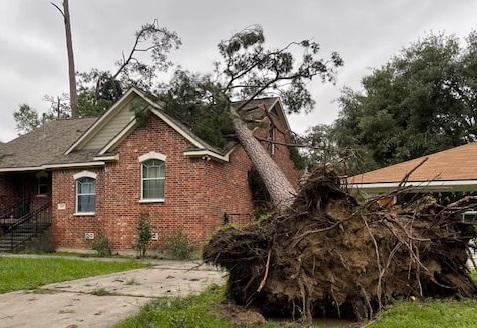
Every summer and fall, Texans wait to see what the Gulf of Mexico will bring. Some years pass with only a few near misses, while others leave entire communities facing weeks of recovery. Forecasts provide guidance, but the truth is that no two seasons look alike.
At Richey Insurance Agency, we’ve seen firsthand how a storm that barely brushes the coast can leave lasting damage. The best approach is steady preparation: reviewing what happened last year, looking closely at what forecasters are saying now, and making sure your property and coverage are in good shape before the next storm forms.
The 2024 season was a reminder of how quickly conditions can shift in Texas. Many residents in the Greater Houston area were still repairing damage from May’s derecho when the first named systems arrived.
Compared with 2023, drought concerns eased, which helped reduce wildfire risks. Still, nature had its way in other ways. In January 2025, a winter storm blanketed parts of the Gulf Coast with freezing rain, sleet, and even snow, causing traffic snarls and stressing already fragile infrastructure.
The National Hurricane Center had predicted an active year with 17 to 25 named storms. When the season wrapped up, the official tally landed at 18 systems, with 11 reaching hurricane strength. Forecasts proved accurate, and Texans felt the impact.
One of the clearest reminders came during Hurricane Beryl, when more than 2 million customers lost power across Houston, resulting in over 143 million customer-out hours. A recent analysis of the blackout found that lower-income neighborhoods experienced longer delays in power restoration even when infrastructure conditions were similar to wealthier areas. For many Texans, this highlighted how recovery challenges extend beyond storm damage itself—social and economic factors often shape how quickly communities can rebound.
For families across the state, the lesson was clear: the threat comes in many forms, from derechos and tropical storms to hurricanes and winter weather. The best safeguard remains forward planning.
Early outlooks for 2025 suggest a season that might be slightly calmer than the previous year, but that doesn’t mean residents can let their guard down. WeatherBell Analytics projects:
| Category | Forecasted Range |
|---|---|
| Named Storms | 15 to 19 |
| Hurricanes | 7 to 9 |
| Major Hurricanes (Category 3+) | 2 to 3 |
One factor influencing these numbers is sea surface temperature. Cooler waters in the Main Development Region, which stretches across the central Atlantic, can limit the number of storms that form. At the same time, warmer conditions farther north could support rapid intensification closer to the Gulf, an increasingly common concern.
Additional forecasts from Colorado State University (expected in early April) and NOAA (mid-May) will add clarity, but the core takeaway never changes: it takes only one storm making landfall to change the year’s narrative.
For property owners along the coast and even in inland counties, now is the time to review coverage options. A standard homeowners policy often leaves gaps for wind or hurricane-related damage. That’s why we recommend reading more about windstorm insurance in Texas to understand where protections may need to be expanded.
The physical risks of hurricanes are visible on the evening news—roofs stripped bare, fences flattened, and water pouring into living rooms. What often surprises homeowners, though, is how their policies respond once a claim is filed.
Most standard policies include fire, theft, and some water damage, but exclude hurricane and wind-related destruction in high-risk areas. That means families in coastal counties, and even those living slightly inland, may discover that damage from flying debris, high winds, or collapsed structures isn’t covered.
In our work, we frequently meet homeowners who only realize these exclusions exist after a storm has already caused damage. One family on the Gulf Coast, for example, assumed their roof repairs would be fully reimbursed after Hurricane Beryl, only to learn that wind-related claims weren’t part of their standard policy. Situations like that are preventable, which is why we encourage policy reviews long before storm season begins.
A dedicated windstorm policy fills these gaps. Coverage usually applies to:
Without this protection, even moderate damage can lead to steep out-of-pocket costs. Think about shingles torn from a roof: water enters, ceilings collapse, and floors warp. Suddenly, a repair turns into a renovation. That’s why having the right policy matters long before hurricane season begins.
For those who want a deeper dive into coverage specifics, you can reach out to us and ask for a clear breakdown of what a windstorm policy typically includes. Knowing the details now prevents unwelcome surprises when the adjuster arrives after a storm.
Texas coastal homeowners often find themselves limited when seeking private wind and hail coverage. That’s where the Texas Windstorm Insurance Association (TWIA) becomes a lifeline. For residents in designated coastal counties, TWIA policies serve as a last-resort option to secure protection when private insurers decline.
From our perspective as business coaches, this situation mirrors what leaders face in their organizations: gaps become evident under stress. Just as a company benefits from contingency planning, homeowners along the coast benefit from knowing TWIA is available if private coverage falls short.
Still, TWIA isn’t a blanket solution. Property eligibility depends on factors such as building codes, windstorm inspections, and compliance certificates. Homeowners also need to match coverage limits to property values, much like business owners must align budgets with operational needs. The process requires forethought—waiting until a storm looms offshore is far too late.
A major concern for many Texans is affordability. Premiums rise steadily in high-risk areas, and the temptation to trim coverage can be strong. Yet there are smarter ways to manage the expense without leaving the home exposed.
In fact, frustration runs deep in some communities. One Texas forum user recently vented that “windstorm insurance seems to be a bit of scam … the cost is like 20% of the roof and they only pay about 50% after deductible”. Comments like these capture a very real skepticism: many feel they are paying too much for too little in return. While those concerns are understandable, what often gets overlooked is how devastating out-of-pocket repairs can be without coverage at all.
Here are some strategies commonly used to keep premiums under control:
In the same way that businesses streamline operations to improve profitability, homeowners can evaluate where adjustments yield long-term savings.
Insurance handles financial recovery, but preparation begins well before the storm makes landfall. The difference between minimal damage and severe loss often lies in the steps taken in advance.
Consider the following checklist:
From a leadership perspective, preparation mirrors effective strategic planning. Leaders don’t wait until a crisis hits to start training their teams or testing systems. They plan early, allocate resources, and communicate expectations. Families can apply the same principle to storm readiness—reduce uncertainty through structure and clear steps.
For readers who want detailed strategies, we’ve published a guide on how to protect homes and vehicles ahead of severe Texas storms.
Forecasts may predict fewer storms in 2025, yet history shows that one direct landfall can change everything. Last year’s derecho and Hurricane Beryl proved how quickly recovery efforts strain communities.
Preparation isn’t an abstract concept. It’s the set of actions—reviewing insurance, reinforcing property, creating contingency plans—that determine how families weather the season. For business leaders, the lesson is strikingly familiar: resilience comes from addressing vulnerabilities before pressure mounts.
Texans who approach hurricane season with foresight are better positioned to protect their property, their finances, and their peace of mind.